AI Disruption: How Markets Are Reacting to Rapid Technological Change


Current State of AI and Its Impacts
Artificial intelligence has advanced quickly in areas like writing, coding, and reasoning. The idea of AI disruption is straightforward. As AI becomes more capable, it is expected to influence industries, the labor market, and the pace of technological progress. I first became interested in how AI shapes real‑world systems during the University of Pennsylvania’s ESAP Artificial Intelligence program, where I worked on a project that used algorithms and real data to improve safety in city navigation. Seeing how quickly these tools are evolving made me more aware of how much uncertainty still surrounds AI’s long‑term impact. Even with all the excitement around recent breakthroughs, AI is still far from reaching its full potential.
There have not been large waves of layoffs or fully self‑sufficient tools that can replace entire teams. Still, the speed of improvement has raised concerns. Companies that fail to integrate AI effectively may fall behind competitors who adopt it faster. This uncertainty has become a major driver of recent market behavior.
Industries Feeling the Most Pressure
Technology companies are currently under the closest scrutiny. The market is trying to figure out which products might be replaced or reshaped by AI, and this has created a lot of volatility.
Large firms like Microsoft and Amazon have been affected, along with cybersecurity companies such as CrowdStrike and Palo Alto Networks. Investors are questioning whether certain software tools will remain essential once AI becomes more capable. As a result, many tech companies have seen sharp declines even though their long‑term fundamentals have not changed dramatically.
Right now, any company whose services could be influenced by AI is being treated cautiously.
Industries Feeling the Least Pressure
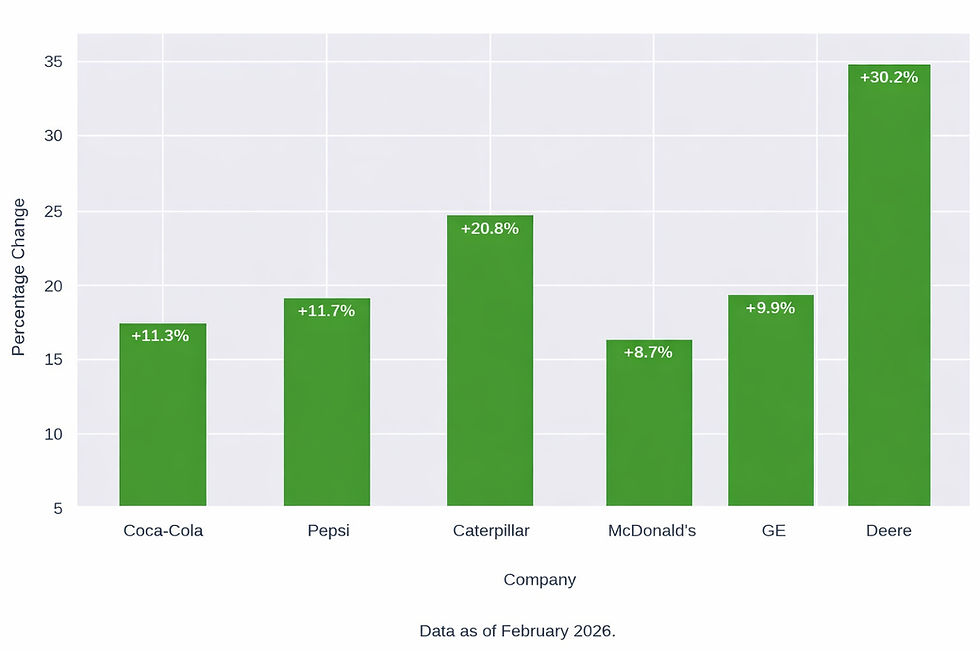
Consumer Staples and Industrials have been some of the most stable areas of the market. Companies like Coca‑Cola, Pepsi, McDonald’s, Caterpillar, and Deere have performed well during the recent AI‑driven volatility.
These businesses are not directly exposed to AI disruption. Their products are physical, essential, and difficult to automate away. As fears about AI grow, investors have treated these sectors as reliable places to hold capital. They are viewed as steady performers in a moment when technology feels unpredictable.
Best and Worst Performing Companies
Recent performance highlights the divide between tech and non‑tech sectors.
Tech and software companies have struggled:

Consumer Staples and Industrials have been strong:
Overall Narrative
The current market reaction to AI is intense, but it does not necessarily reflect long‑term outcomes. Many of the companies facing pressure today remain strong and innovative. The fear is less about what AI has already done and more about what it might do.
Most analysts expect that as AI becomes better understood and more integrated into everyday workflows, the market will settle. The long‑term economic impact is unlikely to be as sudden or disruptive as the current mood suggests. Still, opinions vary, and uncertainty remains a major theme.
Why This Matters
AI disruption is not only a technology story. It is also a story about expectations and market psychology. Understanding how investors react to uncertainty helps explain why some sectors rise while others fall, even when their core businesses remain stable. For students interested in economics, finance, or technology, this moment offers a real‑time example of how innovation shapes markets long before it reshapes daily life.


